NVIDIA Unveils SpatialClaw: A Code-Driven Breakthrough in Training-Free Spatial Reasoning for 3D Models
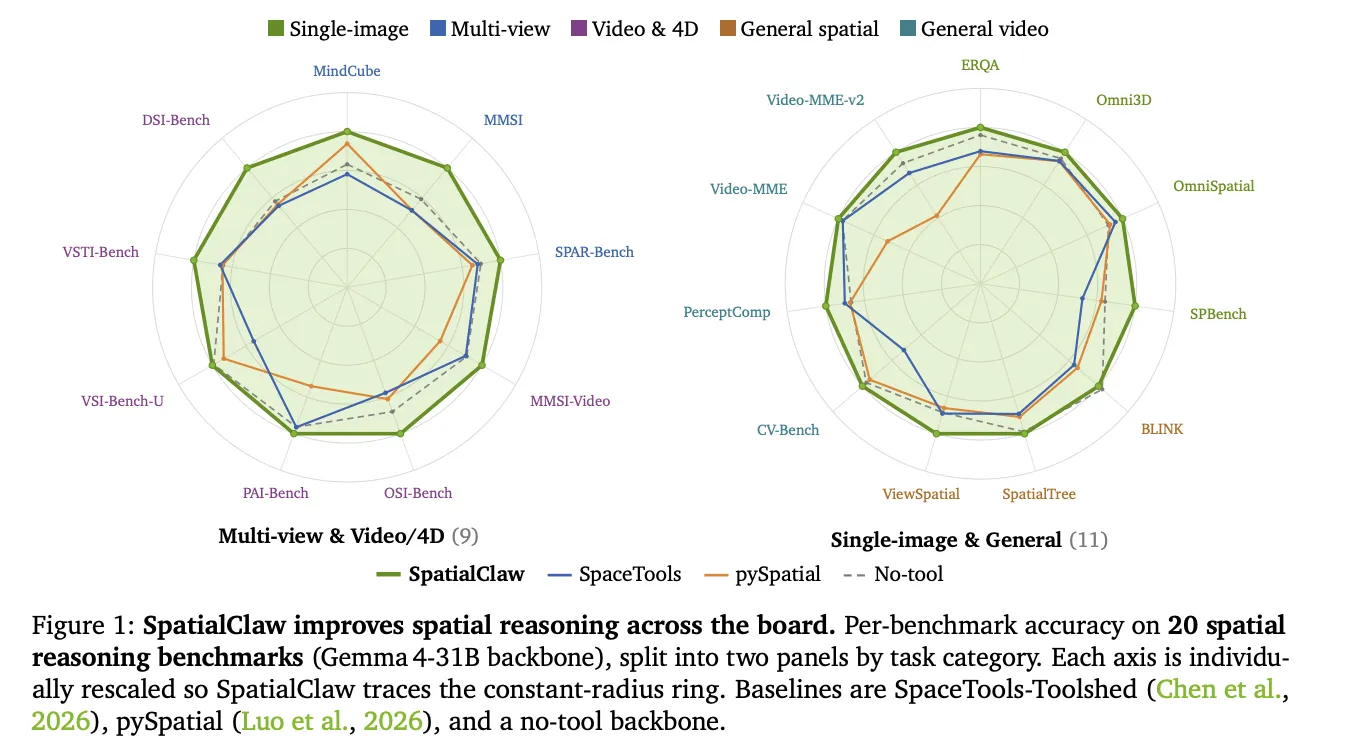
NVIDIA Research has introduced SpatialClaw, an innovative framework designed to overcome limitations in vision-language models (VLMs) for advanced 3D spatial reasoning. By utilizing code as the action interface, SpatialClaw achieves an impressive average accuracy of 59.9% across 20 benchmarks, outperforming previous systems like SpaceTools by 11.2 percentage points.
How SpatialClaw Works for Enhanced Spatial Reasoning
SpatialClaw functions through a stateful Python kernel preloaded with perception tools and input frames. Its key components include:
- Dynamic Code Execution: Six public entry points allow real-time interaction with perception tools for improved spatial reasoning.
- Core Perception Tools: Integration with Depth Anything 3 for 3D reconstruction and SAM 3 for mask generation, enhancing spatial analysis.
- Lightweight Utilities: Features geometry, mask manipulation, time tracking, graph operations, and drawing functions for efficient spatial reasoning tasks.
Unlike traditional methods that require model retraining, SpatialClaw maintains consistent system prompts and hyperparameters across all benchmarks, ensuring reliable performance in spatial reasoning applications.
The Interface Revolution: Code as Action for 3D Spatial Reasoning
Benchmark Comparisons for SpatialClaw
Testing across 20 benchmarks revealed significant advantages over alternative interfaces in spatial reasoning capabilities:
- Single-pass code: 55.2% average accuracy (1.8% improvement over the no-tool baseline for code generation).
- Structured tool-call: 56.7% average accuracy (3.3% improvement for structured code execution).
- SpatialClaw: 59.9% average accuracy (6.5% improvement in spatial analysis).
Dynamic tasks demonstrated the largest gains: DSI-Bench improved by 17.6 points and MindCube by 15.3 points through chained geometric computations for enhanced accuracy.
Industry Impact and Future Directions of SpatialClaw
SpatialClaw revolutionizes spatial reasoning tasks by eliminating the need for model retraining, thereby providing immediate deployment advantages. Its advanced capabilities in handling complex geometric computations across multiple frames position it as a leading solution for:
- Autonomous navigation systems utilizing SpatialClaw technology.
- Industrial inspection automation powered by SpatialClaw.
- Augmented reality applications enhanced by SpatialClaw's efficiency.
- Advanced robotics control systems leveraging SpatialClaw's capabilities.
Current implementation indicates that 52.2% of improvements can be traced directly to SpatialClaw's code composition capabilities, though NVIDIA researchers note that perception quality remains the primary technical bottleneck.